Why Are Most Esports Organisations and Tournaments in Shanghai?
An extra piece by BBKinG (Liu Yang), author of ONE MORE WAY: The History Behind Chinese Esports, published after the book. Translated from the Chinese original: 为什么大多电竞组织和赛事都在上海?
First published in the author's Zhihu column on March 3, 2017: https://zhuanlan.zhihu.com/p/25551392
This translation was reviewed against the Chinese original on August 3, 2026. If you spot a mistranslation, a wrong name, or a factual error, please open an issue or send a pull request.
By BBKinG. Please credit the source if you republish this.
This piece will tell you not only why Shanghai became the centre of Chinese esports as things stand today, but also why the area around Shanghai Circus World in Zhabei became that centre.
The centre of Chinese esports advanced gradually from west to east.
When the internet took off in 1998, the hottest places for esports were not on the coast but deep inland. Chongqing, Chengdu, Xi'an, even Wuhan, were all developing better than Shanghai. The Chinese players who got results early on, Ma Tianyuan, Meng Yang, CQ2000 and Alex in Counter-Strike, and the organisations working behind the scenes, 8DA in the StarCraft era and CCSK in the Counter-Strike era, all belonged to the Sichuan-Chongqing legion.
Chapter 13. Vanguard of the Sichuan Legion: Ma Tianyuan
Chapter 15. The Esports Millionaire Who Came Out of the Slums: Meng Yang
Chapter 30. China's World-Class Counter-Strike In-Game Leader: Alex, Bian Zhengwei
There was one first-tier city in that same period that could have become the centre, and that was Beijing. But the deadly Lanjisu internet café fire and then SARS held back both the growth and the scale of Beijing's internet cafés. Tournaments had nowhere to go, and the atmosphere around esports weakened.
Why was esports so hot inland in those early years?
The pace of life was slower, there were plenty of students, home computers were rare and the internet cafés were large. Many of them started at 200 machines, and chains running 500 to 1,000 machines were everywhere. Business was good, and to bring in custom every café was willing to provide a venue and prize money for esports tournaments free of charge. That is what shaped the esports landscape from 1998 until 2003.
In 2002 there was a split inside CCSK, the website based in Chengdu. The reasons are in my book, so I will not go into them here, but the result mattered a great deal. One group went to Beijing and founded the esports organisation Esai, and the other went to Shanghai and took part in building the Haofang CGA platform.
The pattern of Esai in the north and Haofang in the south began to take shape in Chinese esports.
In this phase Beijing became the centre of Chinese esports, because the big computer manufacturers all had their head offices there. Dell, ASUS, Lenovo and Samsung were all very willing to sponsor esports at the time, and you cannot imagine how much we envied the esports organisations in Beijing.
In 2003 I joined CGA, and in the heat of the Counter-Strike years the Shanghai-based Haofang platform started to become the new esports portal.
But Shanghai had no computer manufacturers. International brands such as Coke and Nike were plentiful in the city, yet esports has never counted as an important advertising channel for them, even today, let alone back then.
That year a new esports discipline began to rise: Warcraft III.
That year an old esports event began to decline: WCG.
WCG held its finals every year at the badminton hall of the Beijing Olympic Sports Centre. After 2003 fewer and fewer spectators came to the venue. Before that the stands had been full; later even the floor seats could not be filled. The atmosphere around esports in Beijing started to fade.
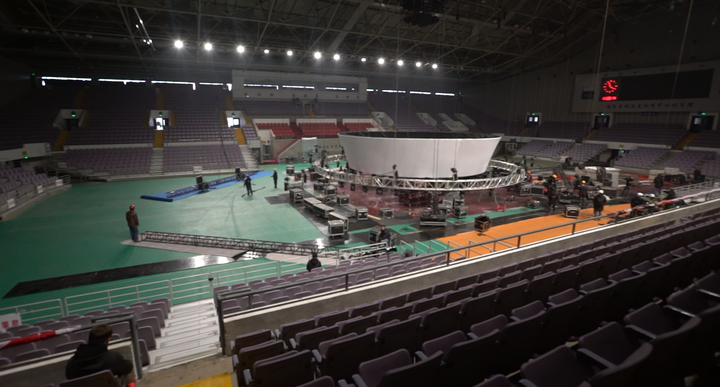
The reasons were complicated. From the audience's point of view, WCG had lost the novelty it had in 2001, and the Chinese team's results abroad were not good either. People in big cities have plenty of options and high expectations, so when an event has nothing much worth watching, the crowd thins out.
In April 2004, SARFT banned the broadcast of games programmes on free-to-air television.
Spending by the computer hardware manufacturers in Beijing began to fall. The reason was simple: it was not worth the money. With no live broadcasts, no television coverage and a return lower than other advertising channels offered, the spending naturally went down.
Beijing's advantages as the centre of esports kept receding over the years that followed.
In 2005 a few unremarkable little things happened in Shanghai.
A Warcraft III enthusiast called Xu Yunbo came back to Shanghai from the United States, in the role of head of IGE's China representative office. IGE was then the largest virtual item trader in the world. It bought World of Warcraft gold in China and sold it worldwide. No logistics, low costs, high margins and deep pockets.
Warcraft III had already become the hottest discipline in esports, and Replays.net had become the new esports portal after CGA.
Xu Yunbo was a devoted user of Replays.net and knew its founder Zax, a fellow Shanghai native, very well. So he decided to put money into building a world-class Warcraft III team. Advertising a virtual item trading business carried policy risk anyway, and the money would be better spent on a team.
So he bought the Replays.net site, and Zax brought KinG in with him to found the WE club in Shanghai.
At the same time he also acquired a video production team called GamesTV. Note that detail.
That year saw the launch of a world-class event, the StarsWar International Star Invitational, which brought the very best Warcraft III players in the world to Shanghai to compete. For many of them, Moon and Grubby among them, it was their first time in the city.
In early 2006 StarsWar 2, held at the Shanghai Changning International Gymnastics Centre, was a great success. It set a record for the live audience at a Chinese esports event, and 250,000 IP addresses watched the online broadcast. It was the first proof that the model of a large offline event plus an online broadcast plus sponsors was a new way forward.
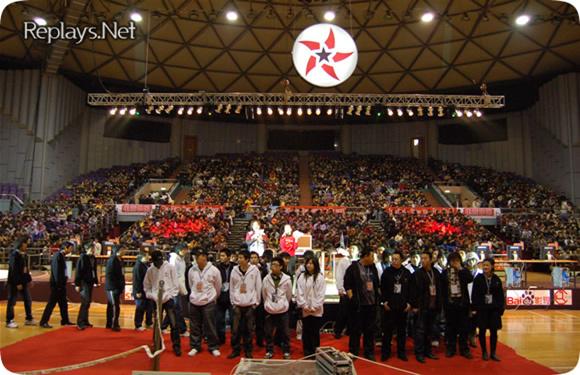
It was at that event that a Taiwanese computer motherboard manufacturer headquartered in Shanghai sent two marketing staff along to supply machines. They saw for themselves the enormous influence esports carried, and from then on the company put its full weight behind sponsoring esports. That company was Gigabyte Technology.
By 2006 Xu Yunbo was worried that GamesTV had no licence to distribute video and that this would cause problems for its future development. So he pushed through a merger between GamesTV and the GamesTV channel of SiTV, part of Shanghai Media Group.
That is where the joint name 游戏风云GamesTV came from. Shanghai Media Group had a cluster of studios at the Huanwei Multimedia Valley on Guangzhong Road West in Zhabei, Shanghai, very close to Shanghai Circus World. It was also where the talent show My Hero was recorded, and in 2007 the G League was born there, in the same studio My Hero used.
The head office of Oriental CJ on Luochuan Road East in Zhabei, Shanghai, was handed over to SiTV in 2008 as well, and that is where GamesTV is based today.
So from 2007 onwards, Chinese esports players and the people who worked in front of the camera and behind it, along with organisations and clubs such as PLU, which had been running StarCraft events in Shanghai all along, the newly founded NeoTV and Beijing's GTV, began turning up around Shanghai Circus World again and again.
Clubs started clustering in Shanghai to make it easier to arrange matches against strong teams
The WE club trained in Xi'an in its early days, because the base there had a China Unicom line that gave faster connections when playing opponents abroad, and because KinG was from Xi'an himself. Later, to make the club easier to manage, the whole operation moved to Shanghai in 2006 and rented a villa in Baoshan District, not far from Zhabei.
In the Warcraft III era the only club in China that could stand up to WE was Beijing's EH. In terms of results, though, WE was far better known, with Warcraft III professionals such as Sky, the back-to-back WCG champion, along with Suho, infl and TED.
In an age when practice matches could only be arranged by team leaders ringing round in person, staff from many clubs, on camera and off, also began coming to Shanghai regularly and passing in and out of that villa in Baoshan.
Venues were easy to apply for in Shanghai
In Beijing over the same period, running tournaments was becoming harder and harder. It was not only that the manufacturers were spending less; getting a venue approved had also become troublesome. Events in Beijing were heavily affected by policy, and if foreign competitors were taking part in an esports event, a document of approval was needed at the level of the General Administration of Sport.
In Shanghai, applying for a venue for an event was relatively simple, because the city was so much more commercialised. As long as your company was legally registered and the fees were paid in full, the police and fire safety procedures were very transparent. Running events in Shanghai kept getting easier, and after 2010 an esports event rarely needed national approval at all.
In 2007 NeoTV took WCG and brought it to Shanghai, holding the Chinese finals at the Shanghai Everbright Convention and Exhibition Centre.
The WCG brand was very nearly dead by then. NeoTV later built it back up, bringing in several Shanghai games companies to run it together, something along the lines of ChinaJoy, and created the trade show business model for WCG.
NeoTV added Dota to the Chinese region, and right up to the final edition in 2013 the event did well both in popularity and commercially. Unfortunately Samsung later shifted its business towards mobile phones and stopped running WCG, and there was nothing NeoTV could do.
The cultural centre of Chinese esports today
Worth mentioning: a few years ago the Sihang Warehouse in Shanghai, where NeoTV had its head office, was due for demolition, and NeoTV moved to the area around Shanghai Circus World in Zhabei as well.
After running the LPL out of Taicang for several years, PLU also moved to the area around Shanghai Circus World in Zhabei.
Teng Linji of GTV left GTV around 2013 and joined GamesTV. His colleague Miss came to Shanghai the same year, also joining GamesTV, and lived near Luochuan Road East in Zhabei. Teng Linji went on to found NiceTV and then VSPN, both of them in the area around Shanghai Circus World in Zhabei.
Yaomo, BBC, 117 and Haitao left GamesTV and founded ImbaTV, again in the area around Shanghai Circus World in Zhabei.
In 2011 the ACE league was founded, with its office at Daning International, again in the area around Shanghai Circus World in Zhabei.
In 2013 WE's parent company moved into the Zhujiang Creative Centre, and now makes the Famulei (伐木累) app, again in the area around Shanghai Circus World in Zhabei.
Today the Zhujiang Creative Centre houses the EDG club, the Snake club, the head office of Wang Sicong's Banana Plan and Panda TV.
In 2016 Riot Games' China company moved to a site behind Daning Music Plaza, again in the area around Shanghai Circus World in Zhabei.
This year the LPL finals are being held at the Super Brand Mall (正大广场) in Shanghai, and the SLi Star Series that ImbaTV has just finished running took place at the Shanghai International Gymnastics Centre. I hear that several mobile game tournaments are going to Shanghai as well. If that is how it goes, essentially every one of China's biggest esports events will be held in Shanghai.
In fact I would very much like to build a large esports arena inside Daning Lingshi Park, right beside Shanghai Circus World metro station. The esports companies are all nearby and the clubs are not far away either. If this area becomes the cultural centre of Chinese esports in the years ahead, and an esports theme park is built here in the future, the location would be far better than the Expo halls over in Pudong.